


Hello, photophiles! Last week broke my streak of consistency, as I couldn’t post anything. But this week, I’m back with something that made me rethink the maker or the made? — a thought that stayed with me as I watched Made In India: A Titan Story
Back in the day, talking about wealth used to be considered a show-off, even slightly bad manners. People inherently preferred to accumulate wealth silently - something I think is still relevant across a large part of South India.
Businesses, in some ways, weren’t very different. Even the maker or the founder of a company was not necessarily known. Rather, I would say that the product or the services they were working to provide through their brand were more known than the maker or the maker’s wealth.
Then came the digital era, and somewhere along the way, the maker started becoming as visible as the make - sometimes even more so.
Today, founders aren’t just building companies. They are building personal brands alongside them. Their opinions, lifestyles, networks, interviews and social media presence become extensions of the businesses they run.
Shoutout to the companies that still manage to make their make bigger than any one person behind it.
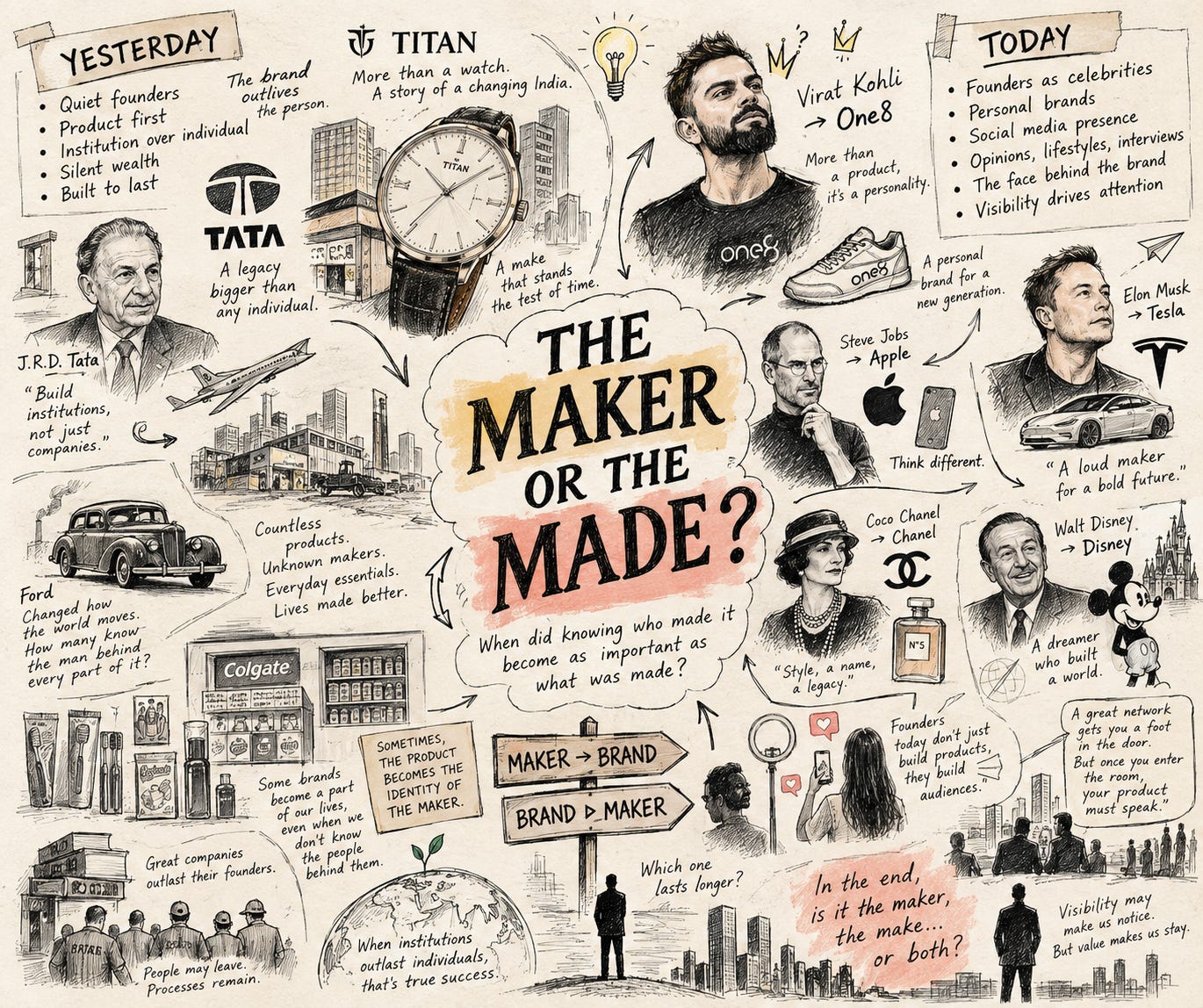
When processes outlast a person, when institutions outlast an individual, I feel that is the true metric to say that a company is successful.
Interestingly, I still see a different pattern among many small and mid-sized businesses across the world. A greater part of their bet continues to be on the product itself - its quality, its usefulness and good old word-of-mouth - rather than on the face card of the people behind it.
Sometimes, the product becomes so successful that it becomes the identity, almost the middle name, of its maker.
With large businesses, though, founders who stay completely away from the public eye seem increasingly rare. The founder has become a storyteller, salesperson, spokesperson and, sometimes, the brand itself.
There is definitely value in that.
A stakeholder’s network can get the company a foot in the door. Their visibility can get people curious enough to enter the room.
But once they are in the room, the product still has to speak.
We have seen businesses with extremely visible founders struggle or shut down because visibility could not compensate for a product that failed to meet even basic expectations.
And perhaps that is where the distinction matters.
Visibility can make me notice the maker.
A network can make me notice the company.
A story can make me curious about the product.
But none of those can indefinitely replace what the company was created to do in the first place.
Its purpose.
Its product or service.
Its quality.
Its usefulness.
Maybe the question, then, isn’t simply whether the maker or the make is more important.
Maybe it depends on what the company is trying to build.
If the company is built around an individual, the maker may always matter.
But if it is meant to become an institution - something capable of surviving its founder, its leadership and perhaps even generations - then eventually, the make has to become bigger than the maker.
Thank You for Reading!
If you’ve enjoyed reading this, please subscribe and share with friends who might, too. See you all next week!

I’d love to hear from you — thoughts, health tips, song recommendations, or anything at all.
Reach out to me!
Email: photopaigaam@gmail.com